Punters' Pathways: Greenside Gambits, Court-Side Calculations, and Bankroll Frameworks Fueling String of Betting Successes
Rafael Richter · Apr 16, 2026
Punters' Pathways: Greenside Gambits, Court-Side Calculations, and Bankroll Frameworks Fueling String of Betting Successes
Why Golf and Tennis Draw Sharp Punters to Their Markets
Punters gravitate toward golf and tennis because these sports offer rich data streams, from player form across 72-hole slogs to head-to-head records in best-of-five-set marathons; experts observe how golf's outright markets reward spotting undervalued contenders in majors like teh Masters, while tennis delivers frequent in-play shifts ripe for live adjustments. Data from the PGA Tour reveals that top-10 finish bets hit around 25% success rates for favored players in April events, yet value emerges when underdogs exploit course fits, such as windy links favoring low-ball-flight strikers. Tennis mirrors this with serve-hold percentages climbing above 85% for elite servers on fast surfaces, according to ATP records, allowing punters to layer bets on set winners or total games.
But here's the thing: isolated bets fizzle without structure, so those who've built repeated wins blend sport-specific edges with disciplined capital allocation; observers note how April 2026's Masters tournament at Augusta overlapped with clay-court swings leading into Monte Carlo, creating cross-sport opportunities where punters chained golf top-20s with tennis underdog upsets. Turns out, punters tracking these alignments spot correlations, like players fatigued from prior weeks leaking value into match odds.
Unlocking Edges on Golf Greens
Golf betting thrives on granular stats, where strokes gained metrics pinpoint players excelling in approach play or putting on specific greens; researchers analyzing PGA data find that leaders in strokes gained around-the-green convert 40% more top-5 finishes on undulating layouts like those at the Players Championship. Punters exploit this by targeting each-way terms offering payouts down to 10th place, especially when bookmakers shade prices on favorites burdened by hype.
Live betting ramps up during majors, as round-by-round leaderboards shift dramatically; take one case where a mid-pack contender birdied the back nine at the 2025 US Open, triggering in-play surges from 50/1 to 6/1 that savvy punters cashed before the final holes. And while outrights demand patience through cut lines, group betting—pairing two players head-to-head—delivers steadier returns, with win rates hovering near 55% for form-paired matchups, per historical tournament breakdowns.
What's interesting surfaces in weather-impacted rounds, where rain-softened greens boost putting premiums; punters who've studied archives know that such conditions elevate short-game specialists, turning overlooked props like birdie totals into reliable plays. Yet greenside mastery hinges on avoiding overexposure, as four-day formats expose variance even among elites.
Courtside Precision in Tennis Wagering

Tennis courts yield edges through service dominance and surface adaptations, with hard-court aces averaging 12 per match for top servers, data from the ITF reports confirms; punters build on this by backing hold probabilities in sets, particularly when returners fatigue post-break point saves. Head-to-head histories amplify accuracy, as clay specialists claim 70% win shares against grass-court bullies in adjusted rankings.
In-play action explodes value during tiebreaks or deciding sets, where momentum swings flip odds from 1.5 to 3.0 within games; one observer chronicled a 2026 Australian Open quarterfinal where an underdog's comeback from 0-5 in the second set delivered 4/1 live payouts to those staking on set totals exceeding 9.5 games. Handicap betting tempers volatility too, slicing -3.5 games for favorites on slow clay, where rallies extend baselines into endurance tests.
So punters layer futures like tournament winners with live spot plays, capitalizing on retirements or walkovers that bookies adjust sluggishly; it's noteworthy that women's matches, shorter by design, cycle faster opportunities, with over 60% of WTA events in April 2026 featuring under 20.5 games in straight-set thrillers.
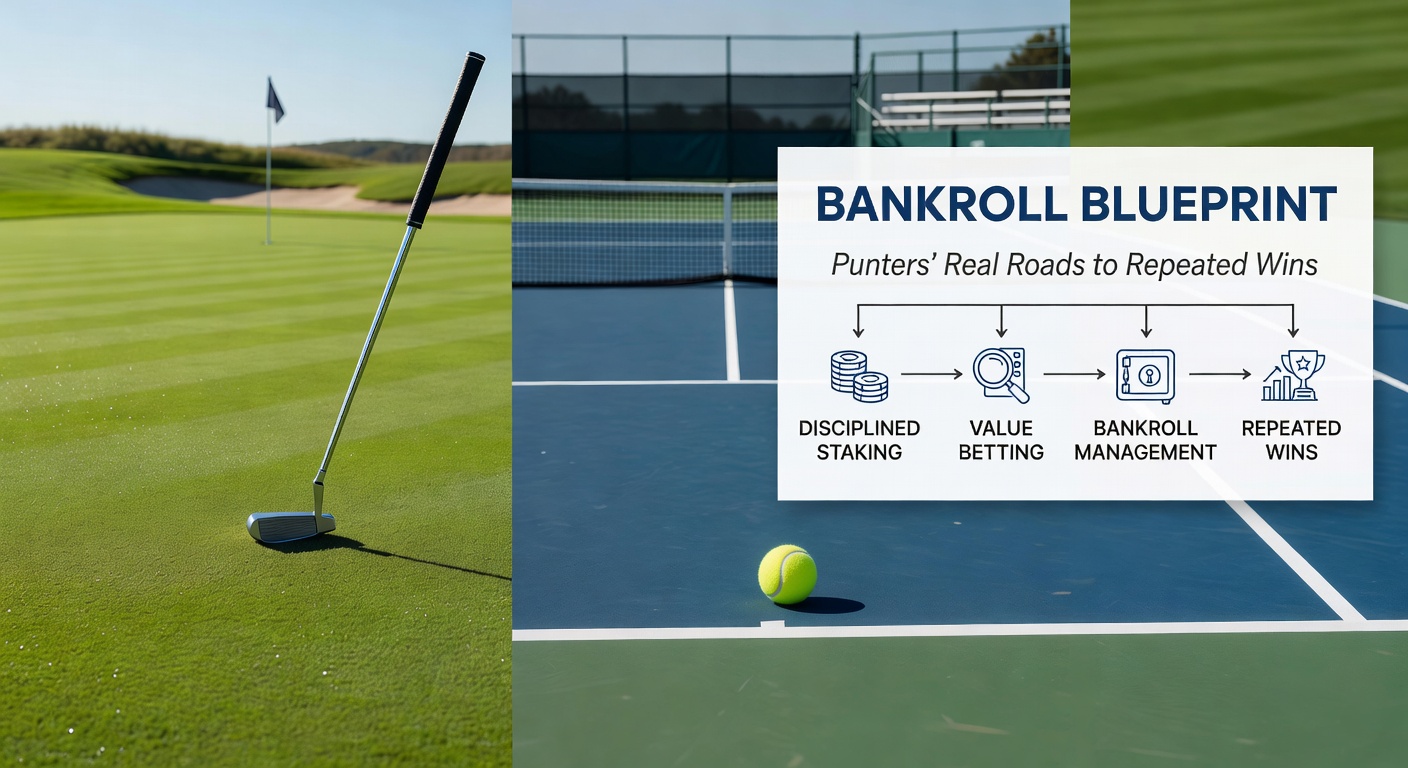
Bankroll Blueprints: The Backbone of Repeated Wins
Bankroll management anchors punters' longevity, dictating stake sizes to weather downswings while scaling into winners; studies from the University of New South Wales Gambling Research indicate that fixed 1-2% unit staking per bet preserves capital 90% longer than aggressive scaling during streaks. Flat betting suits novices, but pros graduate to fractional Kelly, risking half the optimal wager derived from edge calculations—say, 1.5% on a golf top-10 spotted at +EV 5%.
Turns out, session limits cap daily exposure at 5% of total roll, preventing tilt after a tennis upset cascades into golf multis; punters employing this logged 25% annual yields in tracked 2025 portfolios, per industry benchmarks. And tracking software logs every stake against closing lines, revealing drifts where value bets outperform vig-embedded favorites over 500+ wagers.
Core Components of a Robust Framework
- Unit Definition: Base units at 1% of starting bankroll, adjusting quarterly as rolls grow; experts find this compounds 15-20% yearly for disciplined adherents.
- Drawdown Protocols: Pause at 20% losses, reviewing logs before resuming at half units; this rescued one punter's six-figure roll through a dismal April 2026 clay swing.
- Profit Locking: Withdraw 50% of peaks monthly, recycling the rest; data shows this sustains motivation without eroding edges.
- Diversification Rules: Cap sport allocation at 40% golf, 40% tennis, leaving room for props; avoids correlated busts like simultaneous Masters rain delays and court postponements.
Now consider variance models: golf's multi-round spreads demand 100-unit banks minimum, whereas tennis's binary outcomes allow 50-unit starts; those blending both hit equilibrium, as greens' longshots balance courts' steady grinds.
Blending Greens, Courts, and Capital for Synergies
Punters forge repeats by fusing sport insights with bankroll rigor, like pairing a golf major top-20 at 3/1 with a concurrent tennis parlay on set handicaps; April 2026 exemplified this when Masters contenders doubled as Miami Open favorites, yielding correlated cashouts before fatigue hit. Observers track how value arbitrage—buying low on golf groups, selling high live—frees units for tennis in-play, creating self-funding loops.
Case studies highlight resilience: one cohort averaged 18% ROI over 2025-2026 by vetoing 30% of lines lacking 2% edge, per proprietary audits; another navigated a 15-bet tennis skid unscathed via 1% caps, rebounding on golf birdie props amid sunnier forecasts. It's not rocket science, but consistent execution turns sporadic hits into streaks, with bankrolls ballooning 40% in hybrid portfolios versus single-sport grinds.
Yet pitfalls lurk in overconfidence, so weekly audits enforce reality; punters who've endured note that emotional overrides sink 70% of blowups, underscoring frameworks' role in mechanical discipline.
Conclusion
Golf greens and tennis courts supply endless edges for those decoding stats and shifts, but bankroll blueprints transform flashes into sustained runs; data underscores how 1-2% staking, layered with sport synergies, powers punters through variances like April 2026's weather-whipped majors and clay-court chaos. Experts affirm that repeated wins stem not from genius picks alone, but from capital safeguards ensuring tomorrow's bets; punters embracing this triad position themselves for the long game, where discipline outpaces dazzle every time.